Change cycles in the energy sector used to take two to three years. Now they are compressed into six months. New priorities arrive before the last ones have been fully embedded, and the pace of that compression is accelerating. I’ve been attending Future of Utilities events for over 15 years and in that time the agenda has acted as one of the most reliable weathervanes for where the industry’s attention is heading. These events are deliberately forward looking - sponsors and speakers focused on what is coming down the track, attendees there to get an insight into where their work will be directed over the coming months and years.
With AI dominating the conversation at this year’s summit, and to get a feel for how change is actually impacting the industry, I ran an analysis of keyword frequency across the full published agendas for 2024, 2025 and 2026. AI accounted for 21.1% of all tracked keyword mentions in 2026, making it the single most prominent theme in the agenda for the first time. Tracking that shift across three years gives us insight into how the industry’s focus has moved and, perhaps more usefully, an early indication of what is coming next. The picture that emerges is of a sector rapidly restructuring its priorities and doing so at a pace that would have been difficult to predict even two years ago.
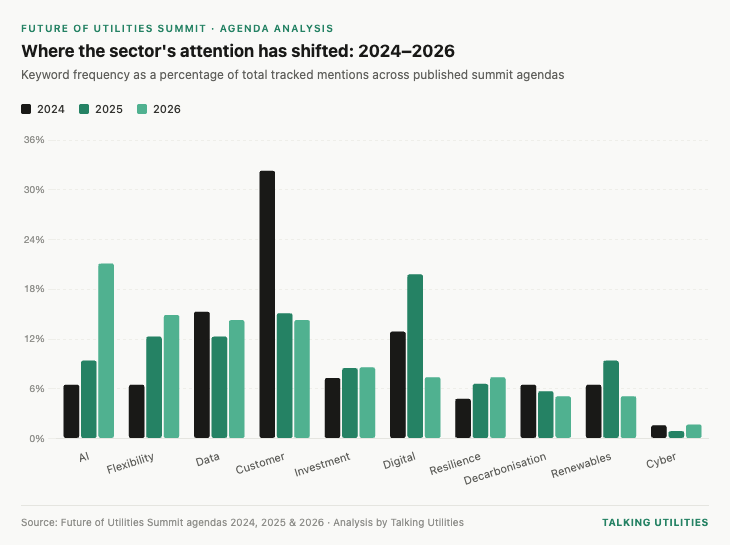
What is perhaps the most telling change is that back in 2024, customer issues dominated the agenda. More than a third of all tracked keyword mentions referenced the customer, reflecting a sector still working through the affordability crisis, the weight of vulnerability obligations and the long shadow of the price cap years. By 2026, that share had almost halved. This is not because the customer challenge has been solved. It is because AI and data are now being framed as the mechanisms through which customer outcomes will be improved, rather than as standalone priorities. The conversation has shifted from “how do we engage customers” to “how do we build the systems that make better engagement possible”.
AI’s trajectory across the three years is the clearest signal of how quickly the sector’s focus has changed. It accounted for a small share of mentions in 2024, saw a modest increase in 2025, and then surged to become the single most prominent theme in 2026. The nature of the conversation has changed as well. The 2026 agenda was not debating whether utilities should adopt AI but rather the harder question of why so many pilots fail to scale and what it takes to build the operational foundations for enterprise-level deployment. The shift is from thinking and trialling to doing and scaling; from proof of concept to governed, accountable infrastructure suitable for a regulated industry.
Unsurprisingly, flexibility tells the most consistent growth story of any theme across the three years. Its steady rise from 2024 through to 2026 reflects a multi-year build in both policy intent and commercial appetite. The Clean Flexibility Roadmap, jointly published by DESNZ, Ofgem and NESO in July 2025, the expansion of virtual power plants, the growth of aggregation models and the emergence of Flex-as-a-Service have all contributed to a sense that flexibility is no longer a niche or future-facing topic. It has become a central pillar of how the sector thinks about system stability, customer value and the economics of electrification. The growing number of sponsors and exhibitors offering the commercial and technical infrastructure to enable flexibility is itself a signal that the market has arrived; capital follows conviction.
Mentions of digital have followed a different arc. It was a significant theme in 2024, peaked in 2025 and then fell sharply in 2026. The most plausible explanation is that AI has absorbed much of the ‘digital’ focus in businesses. Where 2025 was still asking how utilities could become more digitally capable, 2026 was asking how AI could turn that capability into operational reality. The focus has shifted but in reality – it’s all about how technology can speed up progress and improve customer outcomes.
The changing profile of decarbonisation and renewables is one of the more interesting shifts in the data. Both themes have declined over the three-year period, but this is not evidence of the sector losing interest but rather of an industry no longer needing to make the case for it. The 2026 summit did not need sessions arguing for net zero but instead we saw keynotes, roundtables and panels addressing who finances it, how the grid handles it and whether AI can make delivery viable at scale.
Data is the one theme that has remained broadly stable across all three years. That consistency reflects its role as the foundation beneath every other priority. It is the critical basis for AI that works, flexibility that scales and customer engagement that is personalised and delivers measurable outcomes. Data is not an emerging theme. It is the infrastructure that makes all the other themes possible.
Overall, the three-year picture shows a sector that has moved decisively from laying the groundwork to focusing on delivery. The big questions of 2024, centred on affordability, customer outcomes and the case for digitalisation, have given way to harder, more operational questions. How do you govern AI in a regulated environment? How do you build a commercially viable flexibility market? Who pays for the grid transformation that everyone agrees is necessary but must be balanced against affordability and the realities of a constrained investment landscape?
The 2026 agenda made clear that the industry is grappling with ever faster-moving change; evolution has become revolution in the space of a single investment cycle. But pace without inclusion carries its own risks. Consumers are not passive recipients of this transformation; they are the key to unlocking the flexibility future the sector needs. However fast the agenda moves, that is the one thing that cannot be left behind.